
From my Substack. Subscribe today.

Hi.
While researching the ceiling above my bed in preparation for what I would say today, I remembered a lyric that offered a definition of life: “Life is what happens while you’re making other plans.” Like any good lyric, it’s compact, hooky, repeatable, and it sounds right—as if it’s put its finger on something true that’s been just out of reach all this time. It’s known in the music industry as a “bumper sticker,” and it stuck in my head, cycling over and over.
John Lennon sang it. He was in the Beatles, a band that was old when I was young. Perhaps you’ve heard of them. Perhaps you’ve heard that there was a generation before you that’s better than you’ll ever be because they pretty much ensured it by taking what they were given, breaking it, and handing the shards of it to the future.
Better music, better prospects, better everything—perhaps you’ve heard. Perhaps you’re tired of hearing it. Perhaps by now you’re wondering who was making plans while life happened back then. And perhaps you’re wondering what present plans are making life happen today.
“Life is what happens while you’re making other plans.” The lyric attempts to decouple life from planning. It tries to absolve the speaker, and end the conversation. It feels good, momentarily, like a beautiful song, but as this generation grows into its own life, it must reckon with the plans of a previous generation. History is a story of plans and the life that resulted, so there’s a lot riding on who tells the story.
This is not a knock on John Lennon. One can write a bumper sticker, but that doesn’t mean one gets to pick the car it gets stuck on. I think any artist will tell you that. But that’s different than being lulled into thinking that there’s no plan, and that life is just “happening” as it is today. Chaos couldn’t possibly be a plan, right? Wrong. Chaos can be an awesome plan, because when fingers are pointing in every direction, they’re essentially pointing in none. And that’s a great time for shady plans to pass undetected and uncontested. It’s a good time to revise the story.
Perhaps you’ve heard that AI is reinventing the wheel. But it’s not. Theft has always been theft. Thieves are always ahead of the game. They love a population of the distracted, the addicted, the agitated, and the numb. They always move faster than the law. In any chase scene, they’re the ones in front, tossing obstacles in the path of the public good. And they’re executing a plan of escape.
“Life is what happens while you’re making other plans.” It implies that, while planning, life is happening, and that by planning, you’re actually missing it, making you an irresponsible participant in your own life. It asks: Do we influence destiny to any degree, or should we just get ourselves an inner tube and a case of beer and float down the river of life, perhaps to a beautiful cove, or over a falls, into alligator country, or who knows…but that’s the fun of it, right? That’s what “life is.” That’s living.
This philosophy is pervasive, especially among people who are running from something. “Men plan, and God laughs,” you know. That’s a fun one to break out when your plan fails miserably. It shifts the blame to God. Or you might think, “Sweet! If God just laughs, then I don’t have to plan at all.” And you could read it that way. You could rest assured that you have no agency. You might also be the type that uses the phrase, “It is what it is,” without interrogating the linguistic tricks that invite you to shrug as your inner tube cascades over the falls. Lyricists love these tricks, and use them all the time. Here they are:
- Tautology: The phrase “It is what it is” reminds us that A=A. This closed circuit is supposed to shut down any argument and invite a subservient form of agreement, which allows us to go back to floating down that lazy river to wherever our laughing God decides to make life happen. The Stoics would say the important thing is how you react to what this laughing God throws at you. Fake Stoics, now known as podcasters, will buy Marcus Aurelius’ Meditations, and maybe sniff the binding on occasion. Perhaps you’ve noticed the rise of Stoicism on your social media feeds and in conversations around the Manosphere. I first noticed it around the time of the pandemic. Maybe there’s a connection.
- Epanalepsis—the repetition of the beginning of a phrase at the end of the phrase. “People are people,” right? “Haters gonna hate.” “You do you.” It sounds like I’m telling you something, but it’s merely the rhythm of it—the music of it—that makes it sound right. The words can be anything. “Chicken’s gonna chicken.” I don’t even know what that means, but I know it’s hard to argue against.
Why am I telling you this? I’m warning you about our own language, which is weaponized routinely, primarily to get you to fall back asleep, to be complacent, to be pliant, to vote against your interests, to feel powerless, and to forget it, all at the same time. Planning is useless. Life just happens. The outcome is out of all control. We’re in the Matrix, and the red pill is candy coated in delicious gummy clusters of acquiescence. The blue pill just looks like a whole lot of work. Who needs it? It is what it is. Confused emoji.
Rhetorical constructions like these are a lyricist’s stock in trade, and we’re not alone. Artists of all kinds move people by speaking in multi-layered codes that can make sense rhythmically, visually, melodically, or linguistically, which is why governments are scared of artists. Burning books and banning ideas, defunding the arts and sciences, and censoring speech should be a sign: Things do not get banned for having no power.
Does the banning work? Does the story change? Well, I don’t know. Do we know who’s in the Epstein Files? No? Maybe it does work, but let’s be honest, it’s a tedious game of whack-a-mole. So it’s no wonder that governments can’t wait to have AI flood the zone between our ears with gibberish that uses these same techniques to open a void that isolates and separates us. This is the internet’s power: If you can’t change the story, just dilute it—in this case, at unimaginable scale.
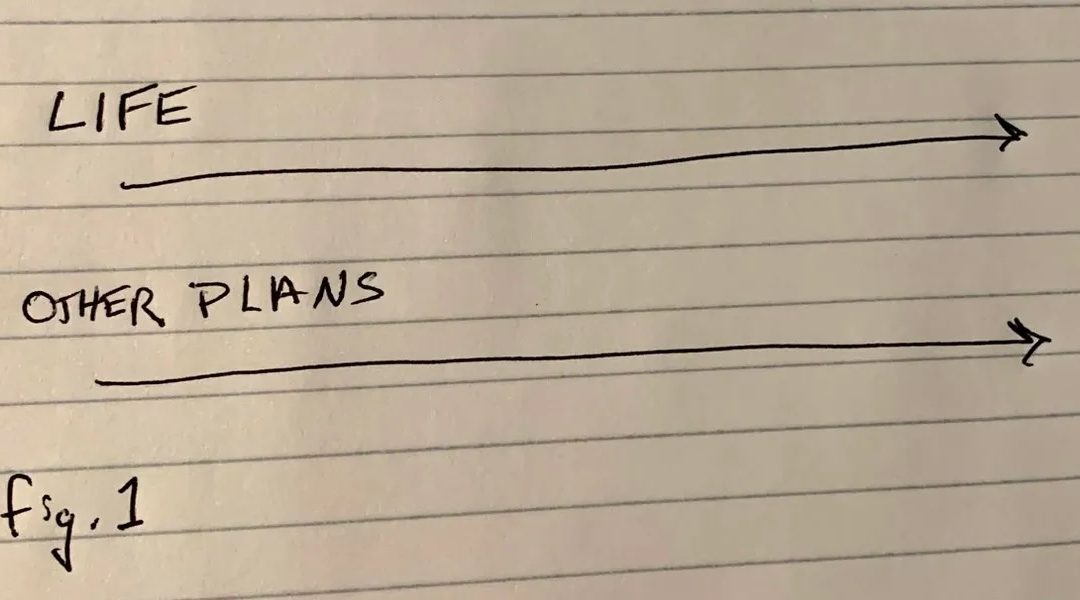
“Life is what happens while you’re making other plans.” You, in your caps and gowns, have been planning for four years. Meanwhile, life has been happening. Which one gives form to the other?

I’m going to guess that the lifeline is the more important of the two. That is, after all, the line we die on.

But is that true? I mean, I get the logic, but I think it’s more clever than true. In other words, it’s another trick. Because: When do we die? I ask, because I’m in constant conversation with the dead. I read dead people all the time. Some of my best friends are dead—that chatroom is full, and the chat is ongoing. The laws in which we live our roller-coaster lives were written out by dead people. In fact, dead people made the roller coaster we’re all on. And they’re all here. With us. Right now.
Which begs yet another question: What happens when your plans outlive you?
Here’s an example: Someone once noticed that it’s not smart to run around the side of the swimming pool. They decided to write the sign “NO RUNNING BY THE POOL.” That person had a plan — to get you to stop running around the pool — and they conceived and executed it while life happened.
I assume that person has since died—God knows how, but I hope it wasn’t from running around the pool, that would be too much—but it happened, and after that, life happened, and life continues happening, and fewer people run around the pool.
What I’m saying is that the dead are here, living through our actions, and guiding our plans. When I tell people not to run around the pool, knowledge is passing from the dead to the living. Do I care which corporeal state my collaborator is in? The plans are alive and anything but futile. It’s life that’s futile—there’s no getting around that terminal point at the end of the line.
Or is there?
Perhaps you’ve heard that we have billionaires dead-set on disproving the futility of life. They are setting their sites on immortality. They want that sci fi brain-in-a-fish-tank life, that eternal summer spent basking in the uploaded algorithm. It all sounds incredibly complicated. It’s going to take data farms, and all your data, and heat, and land, and water, and your 401(k) savings. And for some reason, rockets that explode…a lot.
But is it that hard to do, really? Dear Billionaires, here’s an alternate plan for immortality: Plant a tree. Save a forest. Build a healthcare network. Fund a cure. Paint a sign that’ll stop a kid from biting it by the deep end of every pool in the world.
All this time I’ve been speaking, John Lennon has been “dead.” The song this line comes from, “Beautiful Boy (Darling Boy),” was written for his son, and was inspired by his decision to turn away from the music industry and spend time at home. He wanted a better life. So he made a better plan.
In figure one, I kept the “life” line and the “plan” line parallel, and the astute will know how faulty that premise is. I just did it for clarity. I think we know that roller coasters are not straight, and that plans bump into life, and limitations, and windfalls that change and bend life’s trajectory.
We have a choice. We can float downstream whistling bumper stickers while life happens. Or we can:
Plan, knowing that life happens
Plan, whether or not life happens
Plan, even though life happens
Plan, despite the fact that life happens
Plan, knowing that “not having a plan” is a plan
Plan, knowing that plans fail, but so do kidneys. That’s no reason to abandon them.
Plan, knowing that if you can’t think of a plan, any plan, no matter how small, will take you somewhere new, where a more worthy plan may become more visible
Plan, knowing that the plan is not precious, and can be changed
Plan, knowing that if the plan doesn’t work, you’re going to need a new plan
Plan, knowing that if the plan does work, you’re going to need a new plan
The forces that shape our destiny are concurrent, entwined, and meaningless without each other. And when they are conjugal, life and plan ignite into the actions that define us, reveal our character, and shape our legacy. We walk alongside Immortals while life merely happens, almost in the background. Let God laugh—the indifference is our permission to hatch a plan worthy of the life we get. My hope is that we rise to this moment, knowing the future we create will soon be someone else’s present, our shoulders will be stood upon, and how else are they going to know not to run around the pool if we don’t tell them?
All of my best to the class of 2026. Please plan to come back and visit. I’m going to miss you.
M


Music, Lyrics, and Life, available in print and audiobook.
Or you could just buy me a coffee.